|
Importance of the Garden in Home Planning
By Richard Requa
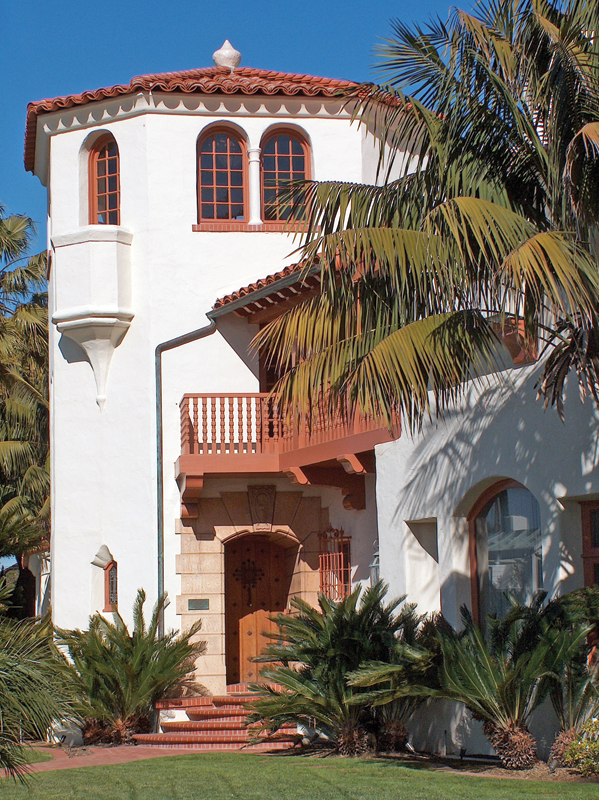
This one and the one below are two homes by Richard Requa and Herbert L. Jackson in Coronado that exemplify the author's philosophy on gardens. Landscape architect Milton P. Sessions worked closely with Requa on all his major projects. William A. Gunn house, 1924-25, at 1127 F Avenue.
|
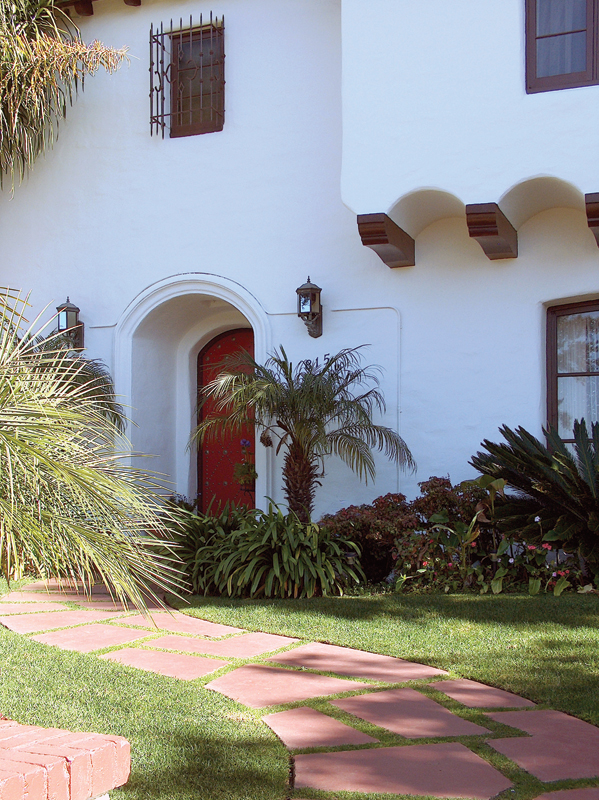
D.H. Theodora Cameron, Esq. house, 1927-28, at 815 Alameda.
|
In spite of all that is being said and written pertaining to floriculture and horticulture at the present time, and the constantly increasing interest that is being taken in these intensely interesting subjects by the general public, it is indeed surprising to note how few prospective home builders give the planning of the garden any thought or consideration until the house is entirely completed and perhaps occupied.
Using a shortened version of his middle name (Lloyd Pietrantonio Ruocco), Antonio Ruocco teamed with architect Kenneth Messenger to form the only local San Diego firm to participate in this program. Ruocco was dedicated to concepts of flexibility and efficiency in design; spaces should be adaptable to their inhabitants. Further, Ruocco believed in economy; new materials like plywood could greatly reduce construction costs. Ruocco, like the elder Neutra, believed that California's mild climate could provide endless possibilities in the form of indoor outdoor connections to enliven and enlarge even the most modest of homes. Sleeping porches, rooftop gardens and bedroom courtyards were considered integral to the design. Ruocco provided six designs for this exhibit. His designs included large panels of floor to ceiling glass as well as rooms that could be divided by curtains allowing for flexibility of space. Ruocco would go on to champion these concepts throughout his entire career.
These early concepts are arguably more relevant today than they were in 1935. As our city grows, economy, efficiency and flexibility of space are more than novel concepts; they are requirements. More impressive yet, Ruocco and many of his contemporaries were able to provide these well designed, economical homes within the context of the land they were built on. Utilizing technological advances in construction these homes could be built on almost any lot without the need for massive amounts of grading and site work. To Ruocco the natural setting was an asset to the structure; natural beauty was to be respected.
The beginnings of Modern design in San Diego is a fantastic discussion; one that will bring much deserved attention to a wonderful group of talented and visionary designers.
The great majority of people reverse the proper order of home planning, failing to realize that the feature of greatest importance, and the one to receive first consideration, especially in this favored section of the country, is the laying out and planting of the home grounds. Even if it be only the conventional 50 by 100 foot city lot, it is surprising what effective results can be obtained, and how much money and temper can be saved, by a little careful study and planning at the proper time.
Be very frank with your architect, fully acquaint him with your hobbies and fancies in the floral kingdom, and discuss this thoroughly, even before the house plan is seriously considered. Have him make a plot plan showing the approximate size and location of the dwelling, and the general layout of the grounds, incorporating your ideas with his extensive knowledge of the subject. With this before you, and taking into consideration the points of the compass, the prevailing wind, the distant vistas, etc., intelligent study can be given the house plans and the best arrangement of its rooms, windows, and entrances.
If, on the other hand, you are to be your own designer, too much care cannot be given this preliminary work. Study your site well. Consult with your florist and become thoroughly familiar with the conditions peculiar to the healthy growth of your favorite plants.
If your site is irregular, uneven or sloping, congratulate yourself, for opportunities exist for unusually interesting and unique gardening effects if intelligently sought for. While certain modifications of the surface are always necessary, a true lover of nature would never completely alter its topography, filling and leveling all slopes and inequalities any more than he would seek to remove the character lines from the human face. Use your best thoughts and efforts to obtain a natural growth and effect, keeping the fact in mind that every tree, plant, shrub and vine should appear perfectly at home in its environment.
After the garden plan has received due consideration, the full attention can be given to the proper planning of the house. The breadth and simplicity of the garden should be reflected in the enclosing walls of the dwelling. The house, in order to meet the requirements of good design, must appear as a part of the surrounding landscape and in perfect harmony with its environment. Its color scheme, therefore, must be carefully considered. Shrubbery close to the building, and clinging vines, are almost indispensable in a well-considered scheme, consequently an exterior finish must be selected that will not be damaged by plants and vines. Brickwork and plaster are good for this purpose besides furnishing an excellent color scheme for almost every setting. A smooth plaster finish, if properly mixed and applied, will last as long as the building, and never need refinishing. The plaster must be smooth float finish, however, and not rough cast, as vines will not cling well to the irregular surface.
In conclusion, and to sum up in few words, allow me to affirm once again, and with all the emphasis in my command, the garden should be the first and foremost in importance in home building. Cultivate a love for plants and flowers, study systematically their habits and requirements and if you are planning for a home, carefully and intelligently lay out your garden plan, then consistently design your house to suit it and if you perseveringly follow out its details, the product will be a source of never-ending comfort and pleasure to you and a delight to all beholders.
This article originally appeared in its entirety in the August 1910 issue of California Garden. Reprinted in parts with permission of San Diego Floral Association, who will feature similar articles and more in a publication due out this year in celebration of their 100th anniversary. To learn more or to visit their archives call (619) 232-5762; email info@sdfloral.org; office location: 1650 El Prado, Room 105, Balboa Park; office hours: 10am-3pm Monday through Friday, and third Saturday of the month.
Photos by Sandé Lollis |
MORE FROM THIS ISSUE
From the Editor
Most Endangered
A Brief History of Rancho Guejito
Another Part of the Story
The Threat
The Beauty of our State Parks in Peril
The Cultural Landscape Connection to Historic Preservation
What is a Cultural Landscape?
The Historic Home Landscape and Gardens
A Short Landscape Glossary
Importance of the Garden in Home Planning
When was Modern New?
Every Bungalow Represents our History
History Repeating
The Sherman-Glbert House
150th Anniversary of the Jackass Mail
Donations
Strength in Numbers
Lost San Diego
DOWNLOAD full magazine as pdf (15.4mb)
|