|
Stick with the Classics
By Beth Montes
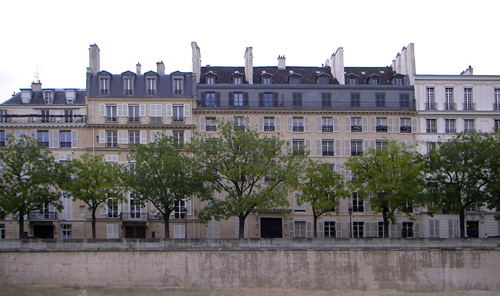
18th century rowhouse apartments along the Seine river
|
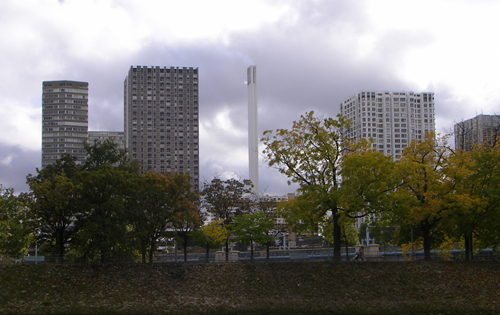
1970's housing, the "Manhattanization" of Paris
|
A slowing housing market can be both a good and a bad thing: good for buyers, bad for sellers. A decrease in demand can also provide a reprieve for historic preservation and preservationists because it gives us a chance to take some proactive steps instead of running around putting out the fires fanned by rabid development.
It also gives us the opportunity to continue our education mission at a time when realtors, property owners, developers, politicians, planners, and architects are more willing to take a breather and listen. At a time when sales are harder to make, it is important for developers to design projects that are more appealing in order to woo buyers. In the best-case scenario this means retaining historic structures, both interior and exterior, and designing the remainder of the development around them. It also means designing new living spaces that fit into their surroundings, have useful floor plans, are of a human scale, and have a general pleasing air.
This concept of good and bad design was readily apparent to me on my recent, and first ever, trip to Europe. After touring around England and Wales for ten days or so, my husband and I took the Eurostar under the Channel to Paris. On the train we sat next to a lovely couple, he was Welsh and she French, who had homes in both London and Paris. On their recommendation, one of the first things we did the next day was to take the Bateau Mouche, a boat cruise. The architecture visible from the Seine was glorious! Bridge after exquisite bridge came slowly into view separated by breath-taking vistas of the Louvre, Musee de Orsay, Notre Dame Cathedral, the Eiffel Tower and more. Beyond the public buildings could be seen street after street of high-density housing. It was hard to think of it as such because that term normally has a bad connotation for me, but that essentially is what is was.
The four, five, and six story apartments were pressed right up against each other and went on for blocks, but did not strike a discordant note - quite the opposite, they were lovely. While still in this state of architectural rapture, the recorded docent began to call attention to the buildings a little further up, and speaking about the "Manhattanization" this part of the city had undergone in the 1970's. My sense of wonder and imagination on fire were quickly doused as the modern, glass and concrete skyscrapers floated into view. They probably housed as many people in a smaller footprint than the glorious old apartments did, and no doubt left more open space between buildings, but at what a cost. The romance was gone, the human scale vanished, the grace and beauty erased. Talk about discordance!
So, while we have some time to reflect during this market slowdown, perhaps all involved in the regulating, designing, financing, and constructing of multi-family dwellings can consider the impact of both thoughtful, pleasing structures and ill-designed buildings upon the spirit - there is a reason that Paris has been considered one of the world's beautiful cities for generation after generation after generation. I say stick with the classics. |
MORE FROM THIS ISSUE
Creating Community Preservation Groups
Stick with the Classics
Rancho to Ranch House
First Do No Harm
Welcome '06-'07 SOHO Board
Borrego Springs Modern II
Much Like Their Buildings
Membership Changes for Dues & Levels
Juan María Osuna Adobe
The H. Lee House
Spending the Holidays with SOHO
Whaley House Museum's October Season is a Resounding Success
Annual Meeting & Elections
Adobe U - Provides Much Needed Repairs to Casa de Estudillo
Interrobang Lecture Series 2007
Whaley House to Celebrate 150th in 2007
Whaley House Docents are VIPs!
Strength in Numbers
Lost San Diego
DOWNLOAD full magazine as pdf (7.3mb)
|