 |
 |
 |
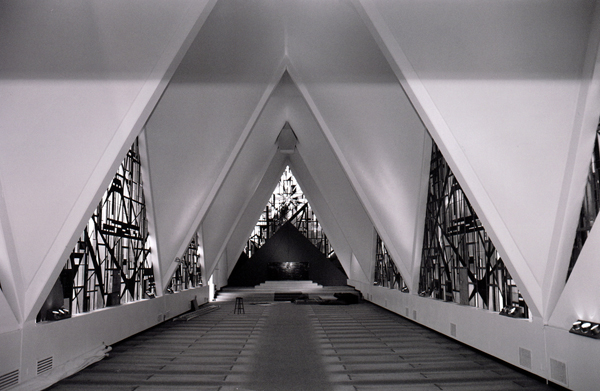
Encinitas Loses a LandmarkBy John Eisenhart On December 16, 2005, the City of Encinitas Planning Commission voted unanimously to raze St. Mark Lutheran Church and approved a parking lot site plan for the Scripps Memorial Hospital. "The Kentucky Fried Chicken Restaurant down the street displays better architectural merit." With such sentiment, the consciousness of the governmental body was resolved to demolish a local iconographic church. The Scripps Memorial Hospital, owner of the property, refused to modify their parking lot design to accommodate the church and with no loss of the 365 spaces in order to let the building stand. No one at the church was willing to talk with SOHO or entertain alternative plans to keep the structure.
The interior of St. Mark Lutheran Church St. Mark Lutheran Church was built in 1961. It was believed to be a replica of a church in Spain. It was a unique structure employing a structural system that is rarely used any longer: the concrete shell. The concrete shell is a reinforced concrete shape that corresponds to the exterior form of the building. The architect, Walter Hagadone and the stain glass artist, believed to be Roger Deracarrera, deserve recognition in their fusing together of form and function to produce a classic mid-century minimalist church. The leaders of architecture, engineering and building were pushing the limits of form and materials. It is saddening to let buildings and landscapes be demolished for such trivial needs as a parking lot. It hurts two-fold when that structure was originally meant to signal a new beginning for a community. The church would have provided a concise understanding of this era's zeitgeist for future generations.
|
2006 - Volume 37, Issue 1MORE FROM THIS ISSUE Frank Lloyd Wright's Legacy in San Diego La Pastorela at the Old Adobe Chapel Because We Need You Now More Than Ever DOWNLOAD full magazine as pdf (8.4mb) |
 |
 |
 |
Mailing - PO Box 80788 · San Diego CA 92138 | Offices - 3525 Seventh Avenue · San Diego CA 92103
|